Sunday, April 17, 2011

Week 8: Networks & Wireless

Networks & Wireless


1. Explain the business benefits of using wireless technology.
Universal access to information and applications; allowing people to be mobile accessing information anytime, anywhere. The automation of business processes; allowing to centralize critical information, and eliminate redundant processes. User conveinence, timeliness and ability to constantely conduct business via iphones etc. 


2. Describe the business benefits associated with VoIP
VoIP = voice over IP. This allows internet to carry voice over digital format eg. phones, faxes, canceling international calls now internet connections. 
Reduces costs through; using existing computer network, no telecommunication charges, & consumers port their numbers between carriers. 


3. Compare LANs and WANs
LANS (Local area network) connect computers that reside in singular geographic location, where WANS (wide area networks) connect computers in different geographical sites. 


4. Describe RFID and how it can be used to help make a supply chain more effective.
RFID (radio frequency identification), are tags that use radio waves to transfer data; used a lot in inventory tracking. 
Using a passive intenna inside a smartcare, having just enough power to send information back to the database increasing ineffeciency.
Passive & active (more data)
Passports; instantely transmitting data to a national security database eg time, date, place etc.
Transportation; such as eTag. 
Travel; 3.5 people use them, automated the ticketing process.
Social retailing


5. Identify the advantages and disadvantage of deploying mobile technology
Advantages include; ubiquity, convenence, instant connectivity, customization (personalized). 


Sunday, April 10, 2011

Week 7: Databases


Databases:


1. List, describe, and provide an example of each of the five characteristics of high quality information
Business decisions are only as good as the quality of information used to make the decisions.
- Accuracy: it is important that information needs to be correct.
- Completeness: needs to be complete to achieve accurate result
- Consistency: making sure that all the data is consistent, eg worldwide data needs consistency
- Uniqueness: eg student registration in notre dame
- Timeliness: being able to extract & deliver information when its needed. eg service orientated architecture

2. Define the relationship between a database and a database management system.
Database is the logical organized collection of data; where the database mgmt system (DBMS) is the actual application. ie. the group of programs that manipulate the database and provide an interface between the database and its users and other application programs,


3. Describe the advantages an organisation can gain by using a database.
Increased flexibility, Increased scalability and performance, Reduced information redundancy, Increased information integrity (quality), Increased information security, accurately store records.
Through the use of a database, an organisation can benefit through; data security (protection from theft,
modification & destruction), data integrity (data meeting constraints) and data independence (applications & data are independent from eachother.) Whilst also preventing; data redundancy, data iscolation & data inconsistency.

4. Define the fundamental concepts of the relational database model.
A relational database is a series of 2D tables that can link to each-other. This allows infinite amounts of data linking to each-other.

5. Describe the benefits of a data-driven website.
By having a database behind the website you only need to update the data once in the website. Development, Content management, Future expandability, Minimising human error, Cutting production and update costs, More efficient, Improved stability, Real time info like stock levels & price changes


6. Describe the roles and purposes of data warehouses and data marts in an organization:
Provide intelligence from many different systems. ie. Relational database management systems specifically designed to support management decision making

Development - allows the website owner to make changes at any time, all without having to rely on a developer or knowing HTML programming. A well structured, data-driven website enables updating with little or no information or no training.
Future expandability- having a data driven website enables the site to grow faster than would be possible with a static site
Minimising Human Error- A well desgined, data-driven website will have 'error trapping' mechanisms to ensure that required information is filled out correctly and that content is entered and displayed in its correct format.
Cutting production costs- convenient and cuts costs, and updates take fraction of time they would with static site
More efficient- system keep track of templates, so users do not have to
Improved Stability- content is never lost, even if your programmer is.

Tuesday, April 5, 2011

Week Five - Ethics and security


Explain the ethical issues surrounding information technology.
> Intellectual property, Copyright, Fair use doctrine, pirated software, counterfeit software. 
Describe a situation involving technology that is ethical but illegal.
>
Describe and explain one of the computer use policies that a company might employee
> An ethical computer use policy contains general principals to guide computer use behaviour. eg. a policy might explicity state that users should refrain from playing computer games during working hours. This publishes work behaviour standards in relation to computers. 
What are the 5 main technology security risks?
> Human error, Technical failures, Natural disaster, deliberate acts, management failure. 
Outline one way to reduce each risk.
>(i) sufficient training on procedures, strong password, strong penalities, firewalls, system audits to track down malicious activity 
(ii)
(iii) Disaster recovery plan; alternative sites, communications plan, business continuity, location of backup data, regular recovery testing, well documented procedures. 
- buy online safely, secure passwords, avoid being phished, avoid spam, secure data, security tips, 
What is a disaster recovery plan, what strategies might a firm employee?

Week 4 Questions, E-Business


Chapter 3 Questions


1. Why has the web grown so dramatically?
> A world wide collection of millions of computers
A network of networks
Enables us to access vast amounts of information
Search Engines are a key Technology
Getting the right information can be a challenge


2. What is Web 2.0, how does it differ from 1.0?


Web 2.0 is referred to as the Live Web. Users can collaborate and build their own content.This differs from 1.0, where it no longer just links text, but links people, where instead people are actively involved in the creation through; tagging, blogs, wiki etc. 


3.How could a web 2.0 technology be used in business?

CEO’s using Blogs to enhance communication, build trust, supplement press releases and talk from the heart.

rss= statistics, or potential consumers with info 


4.  What is eBusiness, how does it differ from eCommerce?


E business also refers to online exhcnages of information (serving of customers & collaborating with business partners), where ecommece is just the buying and selling of goods (online transactions.)
5. What is pure and partial eCommerce
-The product can be physical or digital.
-The process can be physical or digital
-The delivery agent can be physical or digital.


6.  List and describe the various eBusiness models?


- B2B - Business to business- businessess buying and selling to eachother over the internet. Online access to data (shipping date, delivery date, status etc.) - *electronic marketplaces*

- B2C - Business to consumer - products services to consumers over internet. eg. e-shop, e Mall

- C2B- consumer to businesse. eg webmaster offering advertsing services to Amazon.com

- C2C- consumer to consumer; goods and services to eachother, eg online auctions


7. List and describe the major B2B models?


- The major B2B Models is electronic marketplaces (e-marketplaces) which primary goal is to increase market efficiency by tightening and automating the relationship between buyers and consumers.
8. Outline 2 opportunities and 2 challenges faced by companies doing business online?


Two opportunities:


- Increased customer loyality

- Highly accessable

Challenges:

- Protecting consumers: by the unsolicited goods/ services, which may be illegal or harmful.

- Providing security. 


Sunday, March 20, 2011

Week 3 Questions

Define TPS & DSS, and explain how an organisation can use these systems to make decisions and gain competitive advantages
TPS (transaction processing systems) and DSS (decision support systems) can be used to make deciisons and gain competeitive advantages.
TPS is a basic business system that serves the Operational level (analysts) in organization. This emcompassess al of the information contained with a single business process eg. ATM. (daily operational task.- OLTP)
DSS works for complex/unstructured-semi structured problems.  


Describe the three quantitative models typically used by decision support systems. 
1. Sensitivity analysis –variable influencing decisions

2. What if analysis- effect of ‘change.’


3. Goal seeking analysis
> all used as quantative decision support tools


Describe business processes and their importance to an organisation. Business process is a standard set of activities that accomplish a specific task – no automate. These allow a business to reduce costs, thereby making it more effective resulting in an increased profit.

Compare business process improvement and business process re-engineering. Business process improvement (BPI) Is where a business is always improving. Aka a “continuous improvement model”.
A business process re-engineering (BPR) is instead where a business needs to completely re-do and start up the business from scratch.


Describe the importance of business process modelling (or mapping) and business process models. BPM  is different information flows. Ie making the business automated. This adaoption of technology is where the business uses ebusiness models. 


Saturday, March 12, 2011

Week 2 Questions

Explain information technology’s role in business and describe how you measure success?
Information technology is directly linked throughout every aspect in business. 
IT both provides a great insight to anyone learning about business, and gives those an advantage whilse potential to tranform it. 
> Reduces costs, improves productivity & generating growth. role= facilitating communication and inc. business intelligence (each business function.) = effective & efficient. 


Measure IT's success= Usually measuring ROI indicates success rate. Difficult for IT  as hard to tell. egs 'such as is the internal IT operation performing satisfactorily?' or 'How is my outsourcer performing?'
Main important KPI's include
(i) Efficiency and effectiveness metrics;
efficiency measure the performance of the IT system including the throughput, speed and availability. 
effectiveness measure the impact including customer satisfaction, conversion rates and sell-through increases. both ensuring the business is achieving its goals and objectives. 
(ii) Benchmarking (Baseline metrics/ values). This process of continuously measuring system results, comparing to benchmark values and identifying steps to improve. 


List and describe each of the forces in Porter’s Five Forces Model?
Five Forces models maintain competitiveness. 
1. Buyer power: strong buyer power is monopsony ie. one buyer with many suppliers can control the price. This is reduced through loyalty programs (eg. upgrades etc)
2. Supplier power: High when reliant on one supplier (control price, quality and shifting costs. eg microsoft.) This is decreased through standardisation - and easily switch suppliers. 
3. threat of substitute products/services: must maintain competitive advantage to alternatives by switching costs
4. threat of new entrants: Entry barriers are what customers have come to expect and must be offered from a new business to come to survive. 
5. Rivalry among existing competitors: high when competitive market, low when more complacent. Reduce rival power by switching costs.


Describe the relationship between business processes and value chains?
Business process is a standardised set of activities to accomplish a specific task- each of these processess add value to this 'value chain.' play a integral role in strategy execution.
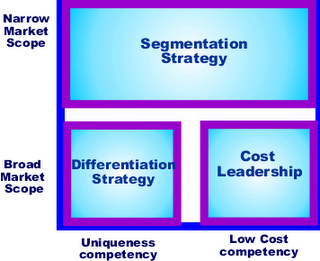
Compare Porter’s three generic strategies?
Through comparison between (i) Broad Cost leadership: low cost to a wide market, appealing to a large audience (ii) Broad differentiation range of prices at several price points  gaining a large stratified audience and (iii) Narrow Focused strategy is niche and somewhat exclusive.